
Expanding My Artistic Vocabulary
For the past year, I have found myself wading ever deeper into exploration and experimentation—learning new materials, discovering unexpected relationships between old and new processes, and allowing curiosity to lead me into unfamiliar territory.
At first, I thought I was simply expanding my technical skills. But gradually I realised something more significant was happening. I wasn’t just learning new techniques. I was developing a richer artistic language.
For years, I assumed that having a recognisable artistic voice was the most important thing an artist could possess. That assumption was reinforced by years of scrolling through Instagram, where we are often told that success depends on maintaining a visually consistent feed. Voice is our way of seeing the world. It shapes the marks we instinctively make, the colours that make us pause and say, “Oh, yes!”, the textures that feel right beneath our hands, and the forms and rhythms we return to again and again. These preferences become our signature.
But recently, I have begun to wonder whether voice alone is enough.
A voice without language is limited by the words it knows.
Living in multilingual Singapore has taught me this. We do not simply speak one language—we borrow from many. Sometimes “I can’t stand this anymore” says exactly what we mean. But sometimes only buay tahan will do—a Singlish expression combining Hokkien (buay, meaning “cannot”) and Malay (tahan, meaning “endure”), conveying a level of exasperation that English alone struggles to capture. Likewise, kena sabo, a blend of Malay (kena, “to be on the receiving end of”) and the English abbreviation sabo (“sabotage”), expresses the familiar experience of being set up or unfairly landed with something. These borrowed expressions are more than replacements for English words; they carry nuances, humour and cultural resonance that would otherwise be lost.
I have begun to realise that materials function much the same way in art.
As a mixed-media artist, I have spent years thinking about colour, line, texture, movement and composition. Yet material itself remained an overlooked part of my vocabulary. I often treated it as the vehicle for the idea rather than part of the idea itself.
Glass has changed that.
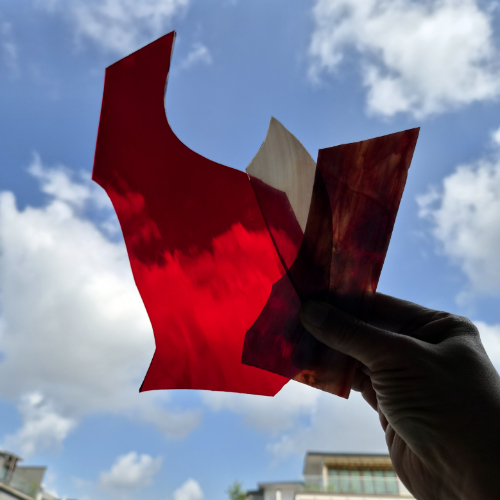
Unlike paint, whose appearance changes with light, glass actively responds to it. It reflects, transmits and refracts light, so that the work is continually transformed as the conditions around it change. It shifts throughout the day, revealing colours, reflections and transparencies that a static surface cannot. It has given me entirely new ways of speaking visually.
Glass is both fragile and resilient. Its transparency can evoke honesty or vulnerability. Its reflective surface can suggest self-awareness. Light itself becomes an active participant in the work, revealing meanings that remain hidden until the conditions are right. Glass resists being understood at a glance. It invites us to linger, as shifting light gradually reveals what was invisible only moments before. In doing so, it allows me to say things that paint alone never could. It has expanded my artistic vocabulary, giving me words I simply did not possess before.
The more I work with glass, the more I realise that artistic growth is not only about finding one’s voice. It is about enlarging one’s language.
Every new material, process or discipline adds another word, another phrase, another way of expressing an idea that previously lay just beyond reach.
Perhaps that is why experimentation matters so much. Every experiment is another word learned, another sentence made possible. In time, we become more fluent.